TradFi Tomorrow Report: How DeFi Is Revolutionizing Financial Services
DeFi is Not Just a Fad – It’s Poised to Transform Traditional Finance
Imagine a world where
Settlement times shrink from days to seconds,
Where back-office costs plummet by up to 25%
Where digital assets and tokenized treasuries redefine liquidity.
The latest TradFi Tomorrow report reveals that traditional finance is already waking up to the power of decentralized finance (DeFi) and blockchain innovation.
Here’s why this matters—and how these trends signal an inevitable shift in our financial ecosystem.
❝
Bonds are coming onchain [a $150T+ market]
Spotlight Story
Paradigm surveyed 300 TradFi professionals
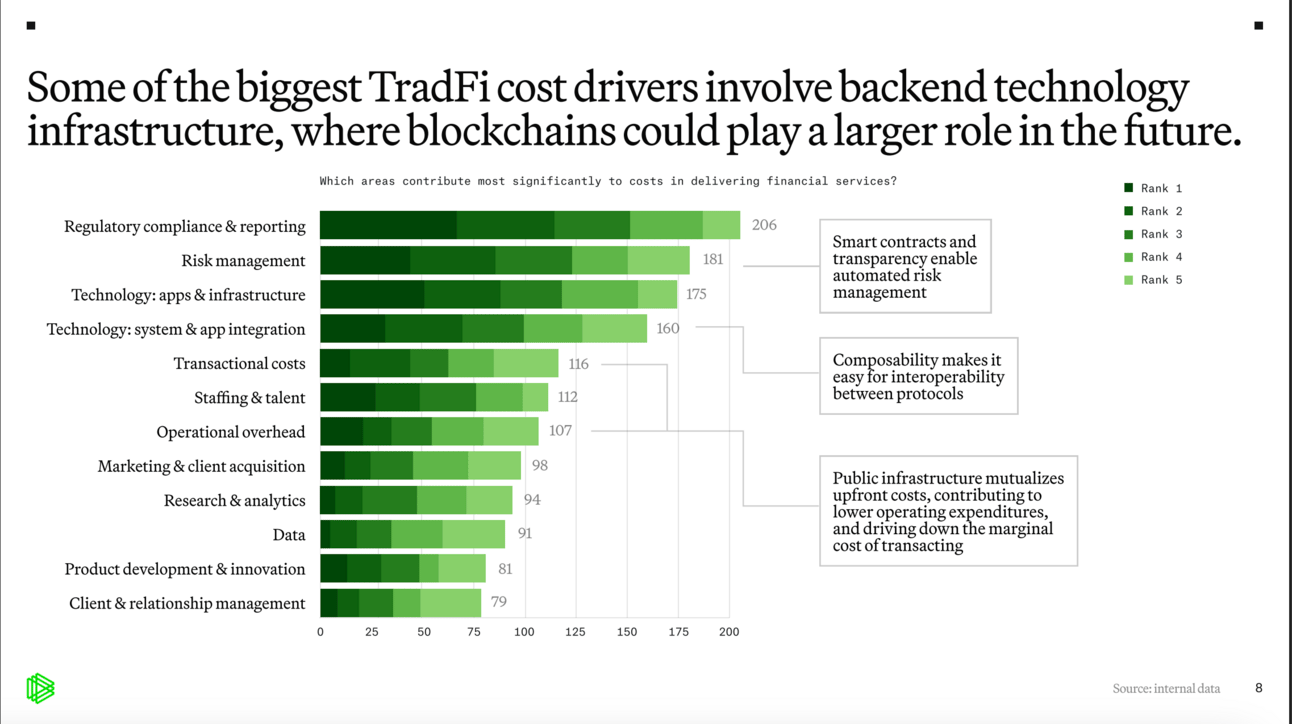
From Paradigm Report
Key Takeaways:
- Over Two-Thirds Exploring DeFi: More than 66% of traditional financial firms are already experimenting with or integrating DeFi solutions, while 76% are involved with crypto initiatives.
- Blockchain & DLT Adoption: 86% of firms currently engage with blockchain technologies, signaling widespread institutional interest.
Automation and Cost Efficiency:
- Back-Office Automation: Approximately 86% of respondents believe that automation is already—or could soon—significantly reduce back-office costs.
- Potential Savings: Automation is estimated to drive around 25% in cost savings, a critical factor for the thin-margin nature of many financial services.
Settlement Speed – A Quantum Leap:
- Traditional vs. Blockchain: While wire transfers and ACH payments can take minutes to days (with additional fees and delays), blockchain networks offer near-instantaneous settlement—Ethereum transactions complete in about 1-2 seconds and Layer 2 solutions in as little as 400 milliseconds.
- 24/7 Operation: Unlike banks that operate during limited hours and are closed on holidays, blockchain settlements run continuously, offering unmatched speed and efficiency.
Drastically Lower Transaction Costs:
- Fee Comparison: Traditional banks can charge anywhere between $25 to $30 per transfer. In contrast, blockchain platforms (such as those used by credit unions on Ethereum or online banks on Layer 2 networks) can reduce fees to mere cents or even fractions of a cent.
- Trend Insights: Daily average transaction fee charts for networks like Solana, Base (Layer 2), and Ethereum highlight a steady decline in fees over time, reinforcing the cost-efficiency of blockchain systems.
Stablecoins and Tokenization – The New Asset Class:
- Stablecoin Dominance: USDC and USDT are emerging as the most popular stablecoins, with overall supply numbers reaching into the hundreds of billions.
- Adoption Metrics: Unique onchain addresses holding stablecoins have seen explosive growth across multiple blockchains—from Ethereum to Polygon—demonstrating robust user adoption.
- Transaction Volume Surge: Stablecoin transaction volumes have soared, with some categories reaching up to $800B, reflecting rapid market activity.
Tokenized Assets – Bringing Traditional Instruments Onchain:
- US Treasuries and Bonds: The report shows that US treasuries have already been tokenized, with onchain supplies peaking around $4.0B. Similarly, tokenized bonds, though smaller in volume, are paving the way for broader adoption of onchain assets.
Regulatory Environment – The Critical Hurdle:
- Clarity Needed: A key takeaway is that 52% of traditional financial institutions cite regulatory uncertainty as the top barrier to deeper DeFi integration.
- Industry Call to Action: The report underscores that a harmonized, supportive regulatory framework could accelerate DeFi’s economic efficiencies, echoing the transformative moments seen with past financial innovations.

Ethereum becomes the financial plumbing
This is the coming of age phase, where decentralized public blockchains become part of the financial plumbing.
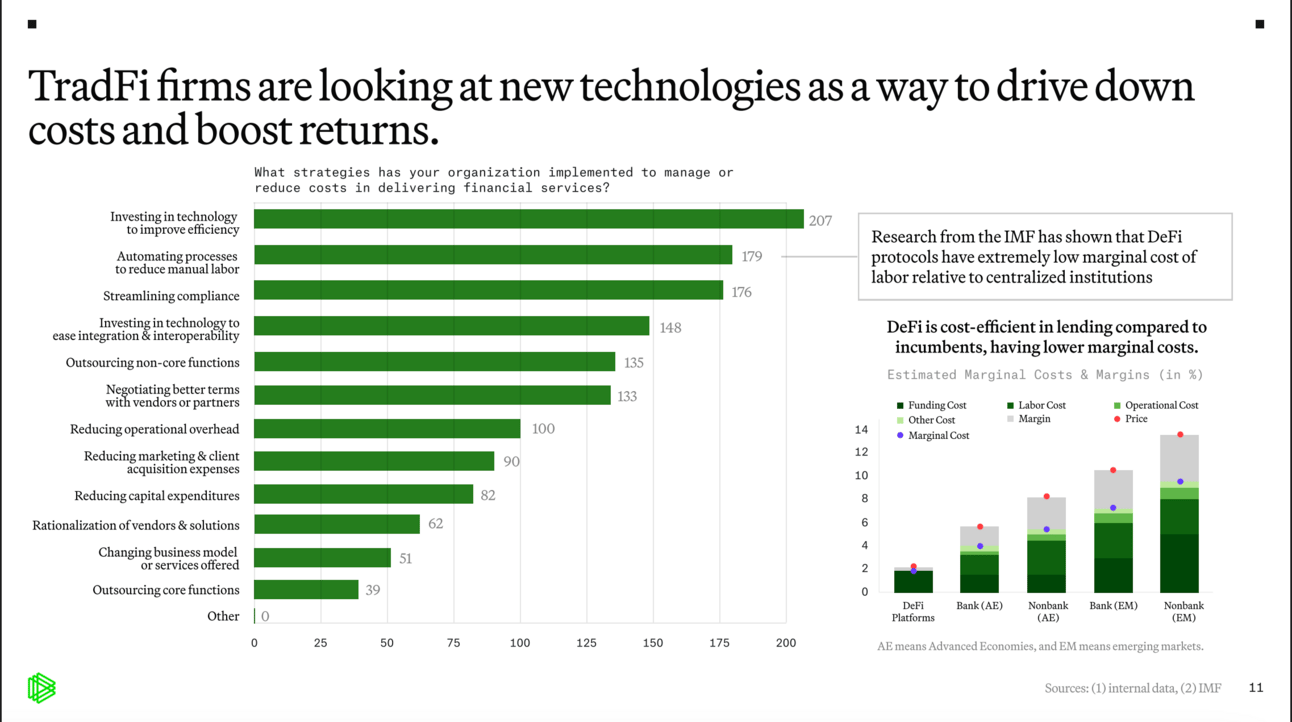
- A Paradigm Shift in Cost Structure: With automation and blockchain cutting operational overhead dramatically, even the most entrenched traditional institutions are beginning to see the benefits of a decentralized approach.
- Instantaneous Global Transactions: The leap from multi-day settlements to near-instantaneous transfers is not just a technical improvement—it’s a revolution in liquidity and cash flow management.
- Asset Innovation: Tokenized assets and stablecoins aren’t just buzzwords. They represent a fundamental rethinking of how traditional instruments can be re-engineered for the digital age.
- Regulatory Leverage: The consensus is clear: if policymakers can clear the fog of uncertainty, DeFi’s potential to unlock unprecedented efficiencies could be realized faster than ever before.